When you get into lifting, progressive overload is one of the main topics people like to talk about. And for good reason; its one of the fundamental concepts if you want to make progress in the gym. Whether it be progressing in strength, power, muscular endurance, or hypertrophy.
One thing that can be overwhelming to some is feeling like you never get to stop progressing. Can you ever stop focusing on progressive overload?
Let’s talk about it. ☕️👀
When is progressive overload necessary?
The truth is- if you want to get stronger, you have to train your body to lift heavier. If you want to build muscle, you have to train your body to handle more volume.
Without progressive overload, you simply plateau.
But you don’t have to keep adding weight or reps if you don’t want to (most of the time).
Do you need progressive overload to be healthy?
Here’s the real tea. You don’t actually always have to keep progressing, that is, if you don’t want to!
Progressive overload is only necessary if you have goals to keep progressing in certain areas of fitness. That is, of course, unless you need progressive overload to stay healthy!
When progressive overload does matter for health is with individuals who struggle with muscular imbalances, postural issues, and those with decreasing bone density over time (measured through DEXA scans and movement/ postural assessments).
Progressive overload in these cases help to prevent osteoporosis, create healthy range of motion throughout our joints, correct posture, and reduce pain.
Otherwise, to remain healthy, lifting weights is necessary 2-3x/ week minimum. Targeting all main muscle groups. The older you get, the more important this habit becomes!
If you are already doing this, and you feel strong and healthy in your body, then you actually don’t have to continue focusing on progressive overload if you don’t care to. You just have to continue maintaining your habits.
When you are strong enough in your body, you should be able to do all of your usual daily tasks with ease, for example:
Carry in bags of groceries
Take the stairs
Pick up your toddler/grandkids/pets
Move furniture
Recreational sports
If you’re able to maintain your lifting 2-3x/ week and can do your daily tasks & hobbies with ease, then you’re in a pretty good place. Just keep maintaining the habits!
How do I know when I can stop increasing my weights?
Well first, there is a limit to how strong we can all individually get, as well as a limit to how much muscle we can build. Every person has a limit to where they would eventually plateau.
Many people end up being happier with their strength or muscle mass sooner than they think though.
This is because most people can completely transform their strength and muscle mass within 1-3 years of lifting when given full effort. But the real tea is that most people keep progressing for fun, not for necessity.
Some people like to challenge their personal limits, seen in sports like powerlifting and bodybuilding, while others prefer to take things slow with no intense focuses or goals around their numbers in the gym at all. This is okay too!
If your goal is to build muscle, you can stop progressing with your weights and your volume once you’re happy with where you are with your muscle size. You can look at “natural bodybuilding” as a reference for what is possible on the extreme sport side.
If your goal is to build strength, you can stop progressing with your weights once you’re happy with how heavy you can lift! You can look at “natural powerlifting” as a reference for what is possible.
When you’re already healthy, the rest is all just for the fun of it.
Try dabbling in other styles of lifting.
Once people achieve their initial fitness goals, and sometimes even before that, they’ll tend to start dabbling in other areas of fitness and lifting.
For example, if someone starts off with bodybuilding training, they may eventually dive into powerlifting, calisthenics, then circuit training; and cycle through these different training blocks throughout the year. This is one of the main things we do with our long-term clients!
One of the most rewarding things you can do to maintain the habit and hobby of lifting for life is to allow yourself to try new things in the gym and to challenge yourself in ways that get you excited!
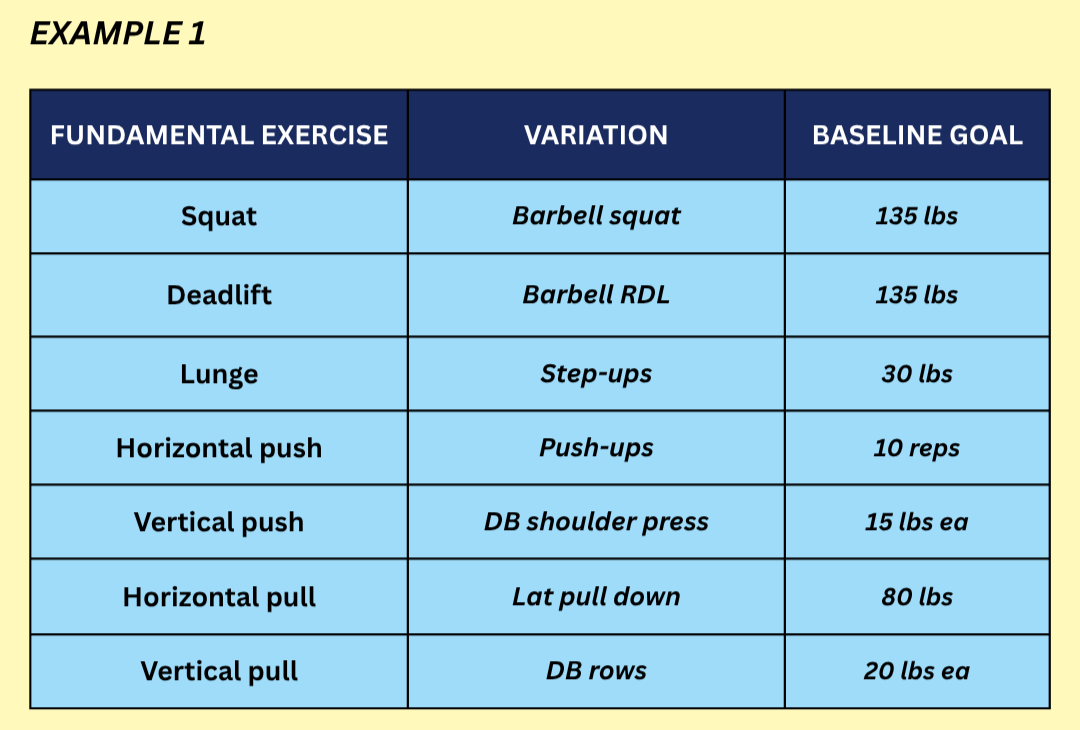
Decide on a baseline standard of strength you can reference.
What I like to do is set my own baseline standard for my exercises, so that no matter what area of fitness I’m dabbling in, I’m still able to maintain my baseline of strength in each exercise. Even as you explore other areas of fitness, you should still be training your full body as you do it.
Most people should be targeting compound movements at least twice a week, so the exercises within the chart should stay relevant regardless of whether you’re doing a metcon workout, bodybuilding, powerlifting, endurance, or circuits.
Having a chart for yourself can help you in feeling secure that regardless of the training block that you’re in, you’re still maintaining a standard that keeps you healthy and happy with where you are.
Here is an EXAMPLE of how a chart may look for a female who enjoys bodybuilding (volume lifting) but still dabbles in other areas of fitness:
Here is an EXAMPLE of how a chart may look for a female who enjoys powerlifting (heavy lifting) but still dabbles in other areas of fitness:
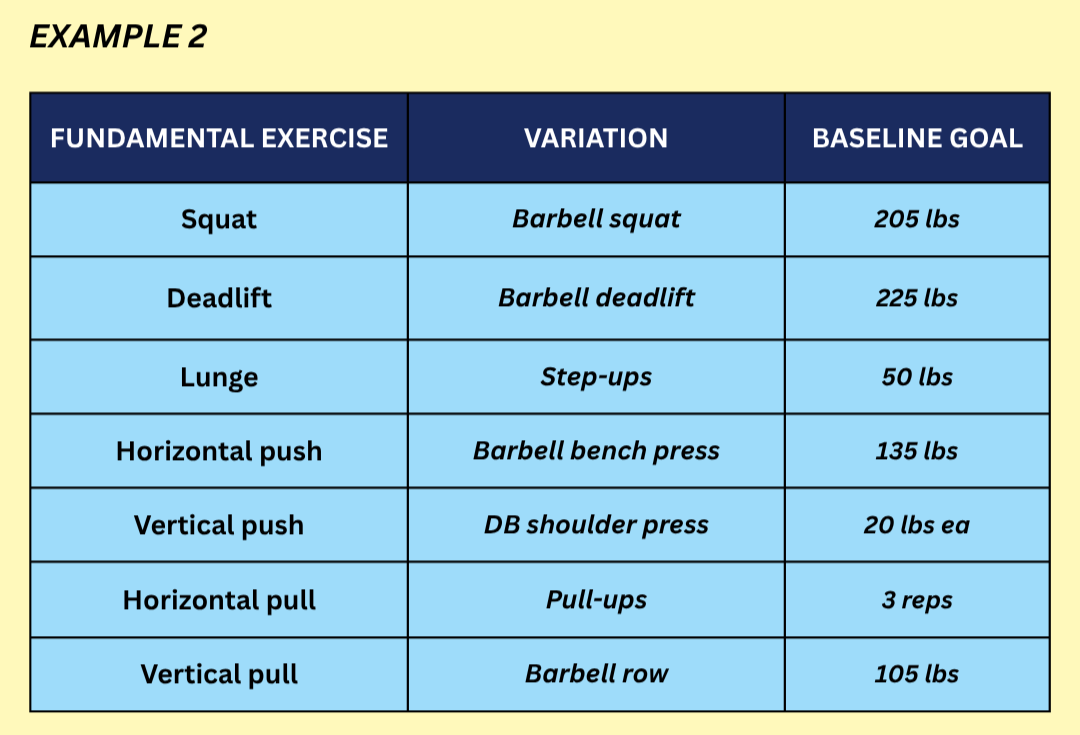
This is just something simple that you can set up for yourself to ensure strength maintenance- once you’re at a place where you’re not constantly focused on progressive overload! If you do this for yourself, adjust your own numbers based on your lifestyle preferences, needs, and hobbies.
The true standard that you can go off of is being able to functionally handle all of the things in your life. Whether it be lifting or moving furniture around your house, picking up your kids/grandkids/pets, or carrying in all of the groceries.
Final Note
Most of the time, there is no true need to keep progressing in the gym with how heavy you can lift. Most people keep progressing for fun. 😊 The most important thing is that you maintain your habit of lifting at least 2-3x/ week and from there, have fun with it!
If creating a baseline for yourself interests you, this is something that can help you feel comfortable in dabbling in other areas of fitness.